Tandoori dishes have a flavour that's instantly recognisable: smoky, spiced and slightly charred, with a richness that lingers well after the last bite. This blog looks at what actually creates that tandoori flavour, from the clay oven itself to the spices in the marinade and explains why ghee plays such a central role in tying it all together.
Tandoori and ghee go hand in hand, even if ghee rarely gets top spot next to the spice blend. This article breaks down what tandoori actually means, the key elements behind its distinctive taste and why ghee, with its high smoke point and rich flavour, suits this style of cooking so well. It also looks at a few popular tandoori dishes and how to bring some of that flavour into a home kitchen.
Order a tandoori dish at a restaurant and the flavour is hard to mistake for anything else: smoky, slightly charred, layered with spice and finished with a richness that coats every bite. Getting that tandoori flavour right at home is trickier than it looks and ghee often turns out to be part of the answer. Anyone stocking up on organic ghee UK for their own kitchen might not immediately connect it to tandoori cooking, yet the link between tandoori and ghee runs deeper than most people realise. This article looks at what tandoori actually is, what creates its distinctive taste and why ghee earns its place in the process.
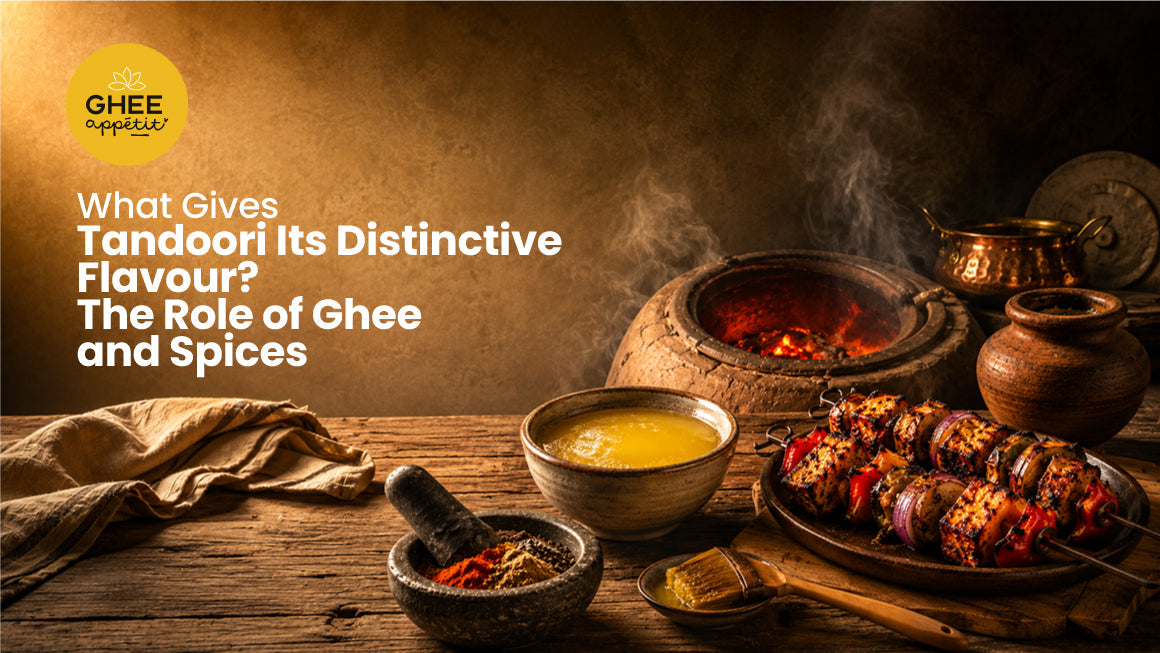
Tandoori refers to food cooked in a tandoor, a cylindrical clay oven traditionally fired with charcoal or wood, capable of reaching extremely high temperatures, often cited at around 480°C. The technique has roots going back thousands of years to the Indus Valley and it later became closely associated with Punjabi and North Indian cooking, particularly for meats, breads and vegetables cooked on skewers or pressed directly against the oven's hot interior walls. Tandoori cooking is defined as much by the equipment as by any single ingredient, since the intense, even heat of the clay oven is what gives tandoori dishes their particular character, something difficult to fully replicate with a standard oven or grill.
A handful of elements come together to create tandoori flavour and it is really the combination that matters rather than any one ingredient working alone. The tandoori marinade, usually built around yoghurt, is one starting point, since the yoghurt tenderises whatever it coats while helping the spices cling to the surface. Tandoori spices typically include a mix of paprika or Kashmiri chilli for colour and gentle heat, cumin and coriander for an earthy base, garam masala for warmth and turmeric for a subtle depth. The clay oven itself contributes a smoky flavour that no amount of spice alone can fully recreate, along with the charring that develops on the exterior of whatever is being cooked. Ghee is the final piece, since it carries flavour, helps prevent the exterior from drying out under high heat cooking and is often brushed on either during or after cooking to finish the dish.
Ghee earns its place in tandoori cooking largely because of how it behaves under heat, a pairing that goes back to traditional cooking practice long before anyone treated it as a modern trick. Traditional tandoori cooking involves extremely high temperatures and ghee has a notably high smoke point compared to many other fats, meaning it can be brushed onto meat, bread or vegetables without breaking down or turning bitter the way some oils and butter can at similar temperatures. Its rich, nutty flavour also complements the spice blend rather than competing with it, adding a rounded finish that plain oil simply does not provide. Many cooks brush clarified butter ghee over tandoori dishes just before or after they come off the heat, which helps lock in moisture and gives the final dish that glossy, slightly rich finish associated with restaurant-style tandoori food. It is a small step, but one that makes a noticeable difference to both texture and taste.
Tandoori chicken is probably the best known example, marinated in yoghurt and spices before being cooked at high heat, often finished with a brushing of ghee to add richness and shine. Tandoori roti and naan also benefit from ghee, typically brushed on fresh out of the oven while the bread is still hot enough for it to melt straight in. Vegetable and paneer versions of tandoori cooking follow a similar pattern, using ghee both within the marinade and as a finishing touch, since paneer in particular benefits from the added moisture ghee provides during high heat cooking. Across most tandoori dishes, ghee tends to appear less as a headline ingredient and more as the finishing detail that ties the whole dish together.
Very few home kitchens have an actual tandoor, but that does not rule out getting reasonably close to the flavour. A hot oven or grill, pushed as high as it will safely go, can mimic some of the char and intensity a clay oven provides, particularly if the food is placed close to the heat source for the final few minutes of cooking. Building a proper tandoori marinade with yoghurt, tandoori spices, ginger and garlic remains essential, since the marinade does much of the flavour work regardless of the cooking method. Using organic cow ghee, or specifically ghee organic grass fed in origin, as a finishing brush both during and after cooking helps bring some of that traditional richness to the dish, even without the clay oven itself. For those checking labels, lactose free ghee is also worth looking for, since the clarification process removes most of the milk solids responsible for lactose in the first place. Consistency and even heat matter more than fancy equipment when it comes to getting reasonably close to that tandoori flavour at home.
Tandoori flavour comes from several things working together: the clay oven's intense heat, a well-built marinade, a specific blend of tandoori spices and a finishing touch of fat that ties everything into one rounded taste. Ghee fits naturally into that picture, thanks to its high smoke point and the depth it adds without overpowering the spice blend underneath. Pure ghee UK options and organic grass fed ghee are both worth trying the next time tandoori cooking is on the menu and it is worth buying clarified butter to see what that small addition brings to the dish.
Zest and Zing. What Is Tandoori? Its Taste, Spices & How It's Used in Cooking [Internet]. [Accessed 2026]. Available from: https://www.zestandzing.com/blogs/7spices/what-is-tandoori-its-taste-spices-and-how-its-used-in-cooking
Encyclopaedia Britannica. Tandoori Cookery [Internet]. [Accessed 2026]. Available from: https://www.britannica.com/topic/tandoori-cookery
Escoffier. Tandoori Cooking: 5 Secrets Behind Indian Clay Oven Techniques [Internet]. [Accessed 2026]. Available from: https://www.escoffier.edu/blog/world-food-drink/tandoori-cooking-5-secrets-behind-indian-clay-oven-techniques/
This article is intended for general informational purposes only and focuses on the culinary technique, flavour and traditional background of tandoori cooking. It does not constitute health, medical or nutritional advice. Please consult a qualified professional for guidance specific to your circumstances.